Wednesday, June 25, Prague
|
Old Town Hall
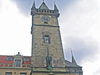
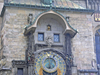
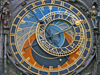
The Prague Astronomical Clock (Prague Orloj) is a medieval astronomical clock installed in 1410, making it the third-oldest astronomical clock in the world and the oldest clock still operating. The Orloj is mounted on the southern wall of Old Town Hall in the Old Town Square. The clock mechanism itself has three main components: the astronomical dial, representing the position of the Sun and Moon in the sky and displaying various astronomical details; statues of various Catholic saints stand on either side of the clock; "The Walk of the Apostles", a clockwork hourly show of figures of the Apostles and other moving sculptures - notably a figure of Death (represented by a skeleton) striking the time; and a calendar dial with medallions representing the months. According to local legend, the city will suffer if the clock is neglected and its good operation is placed in jeopardy; a ghost, mounted on the clock, was supposed to nod its head in confirmation. According to the legend, the only hope was represented by a boy born on New Year's night.
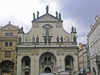
Church of St. Salvator, located in the Klementinum complex. The Klementinum is a historic complex of buildings. Until recently the complex hosted the National, University and Technical libraries; the City Library was also nearby on Mariánské Námestí. In 2009, the Technical library and the Municipal library moved to the Prague National Technical Library at Technická. It is in use as the National Library of the Czech Republic.
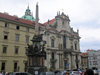
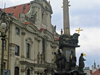
Holy Trinity Column, erected in 1715 to commemorate the end of a plague epidemic.
Baroque Library Hall located within the Klementinum complex. Completed in 1722, the hall features ornate wooden bookshelves housing over 27,000 rare theological volumes. The ceiling is decorated with frescoes illustrating themes of science and art. The interior also contains historic globes and a mechanical clock designed by Copernicus. |